Microduck: What Goes Into Building a Tiny Robot That Walks and Picks Things Up?
Explore how Microduck learns to move, how its hardware supports those behaviors, and what product teams can learn about developing a custom robot.
A little robot duck waddles toward an object on the floor, lowers its body, closes its beak around it, and stands back up. Fit it with roller-skating accessories, and it has another way to move. Microduck makes robot motion control easy to picture: a small machine using its body to interact with the world around it.
For teams developing robots, interactive toys, or smart hardware, the project offers more than an interesting demonstration of learned movement. It also shows how product design supports those behaviors. Bringing an appealing character to life takes electronics, joints, sensors, mechanical parts, and software working together.
What Is Microduck?
Microduck is a small bipedal robot developed by Pollen Robotics. Preorders opened on August 27, 2026, at an introductory price of $399, excluding taxes and shipping. The robot stands approximately 25 cm tall, weighs around 800 g, and includes 15 motors, a camera, a depth sensor, and two inertial measurement units (IMUs). These figures reflect the published specifications; as of the verification date above, the product was still available on a preorder basis. Source: Microduck official product page
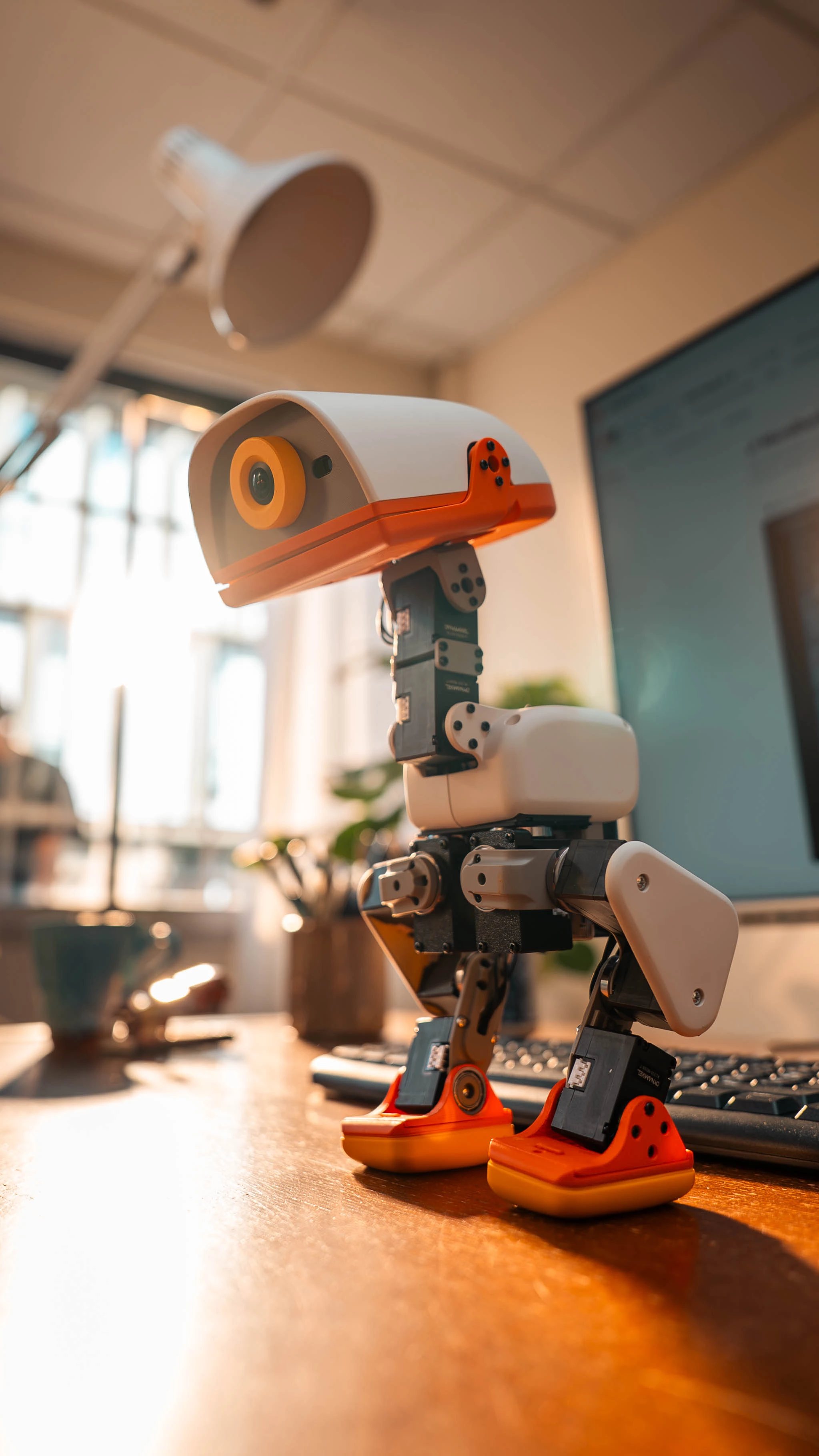
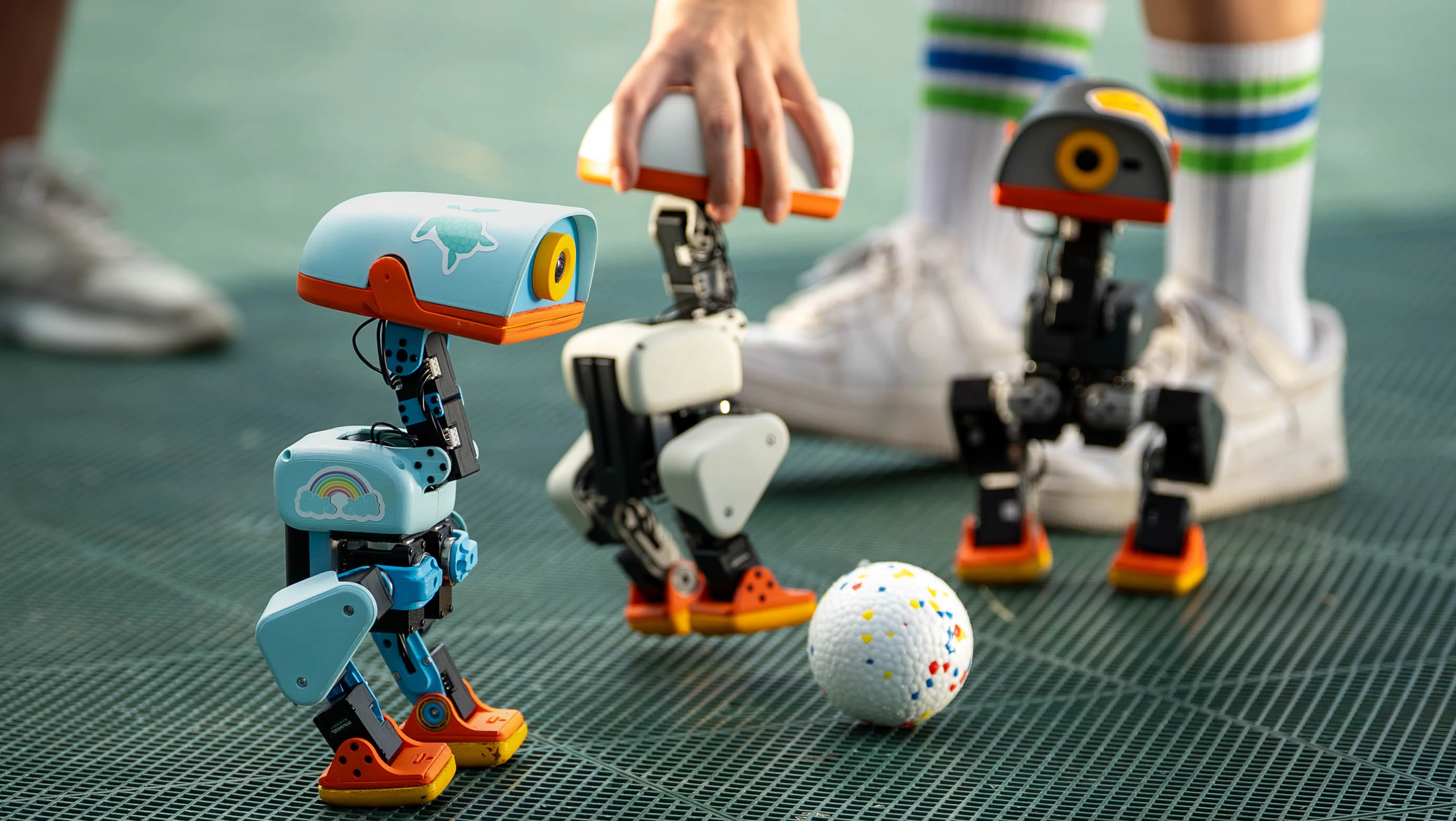
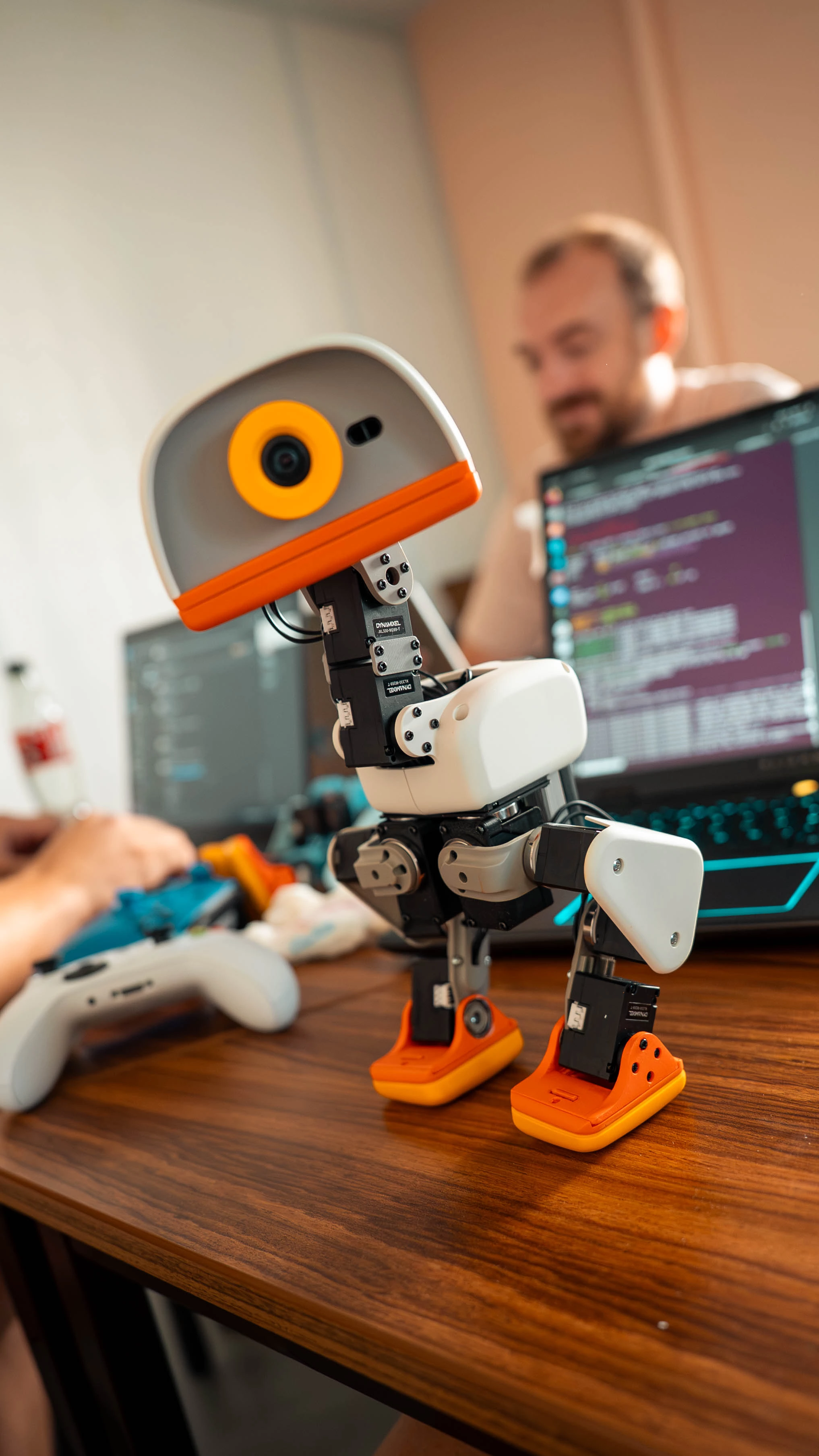
Its articulated beak can grasp small objects, while its legs provide support and movement. The head and neck also move as the robot changes posture. Together, these mechanisms produce the complete action a user sees: a little duck bending down to pick something up.
In its launch blog post, Pollen Robotics describes Microduck as a way to explore how robots act: train a behavior in simulation, transfer it to a physical machine, observe what happens, and refine it. At its core, Microduck gives developers a practical platform for experimenting with robot movement and reinforcement learning. Source: Pollen Robotics — Meet Microduck
Why Give a Robot the Shape of a Duck?
Microduck’s character is closely tied to its mechanics. According to the development team, the duck identity grew from the robot’s proportions, beak, and waddling gait. Its small, lightweight body also makes movement experiments more manageable on an ordinary workbench or in a classroom. Source: Pollen Robotics launch blog
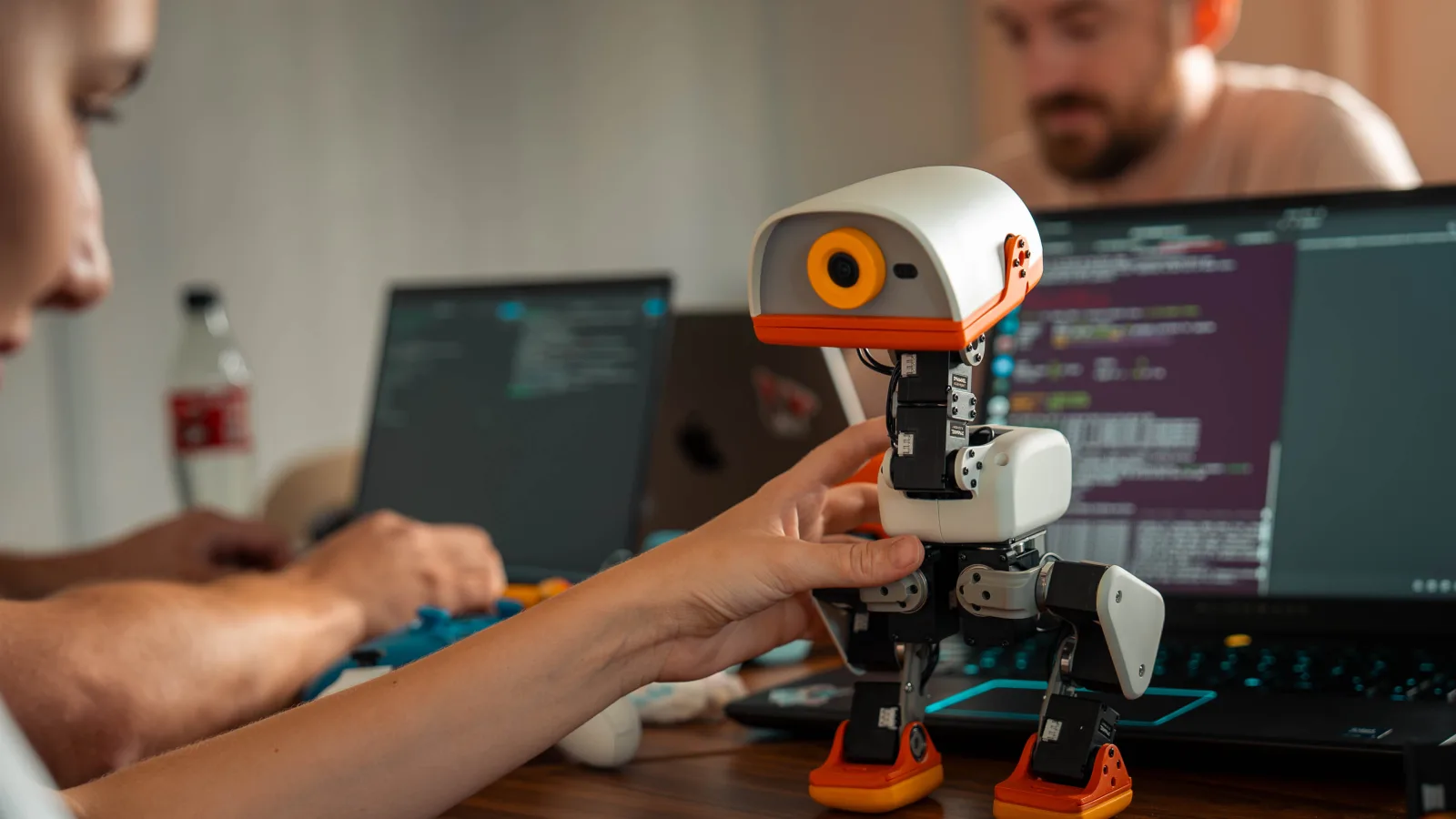
There is a useful product design lesson here: appearance, function, and movement can develop together. The beak gives the robot a recognizable face while serving as a mechanism for handling objects. The way its body sways is part of both its locomotion and its personality.
For a team developing an interactive robot that nods, follows a target, or carries lightweight objects, those behaviors should inform the design from the beginning. Early sketches need to account for the required joints, their range of motion, and how the body will remain stable. A character designed with those constraints in mind has a clearer path from concept art to a working prototype.
How Does It Learn to Walk and Perform Actions?
To understand Microduck’s learning process, it helps to separate training from execution.
During training, a virtual robot repeatedly attempts a task in a physics simulator. Its control policy is adjusted according to the task objectives—for example, following a requested walking speed while remaining stable. The resulting policy is then deployed to the physical robot, where it continually determines actions based on the robot’s current state.
The official Microduck training project uses mjlab, built on MuJoCo Warp, with the PPO reinforcement learning algorithm. Trained policies are exported in ONNX format for deployment. The published policy loop runs at 50 Hz, or roughly 50 updates per second. Source: Microduck RL official repository
The ability to train new behaviors does not mean the robot can instantly learn any skill from a spoken request. Developers still need to define the task, train the policy, and validate the result. For product teams, the intended behaviors must be planned alongside the mechanical design, actuator capabilities, and available development resources.
Why Do Hardware Details Matter When Moving from Simulation to Reality?
A virtual robot that walks steadily does not guarantee a physical prototype will behave the same way. Microduck’s training project accounts for factors including actuator friction, battery voltage, voltage drops under load, command delays, and gear backlash. Varying simulation conditions helps policies cope with differences they may encounter on real hardware. Source: Microduck RL actuator models and simulation documentation
The engineering implication is straightforward: the software model needs to represent the hardware closely, while the manufactured units need to be consistent. The following considerations apply to the development of similar robots; they are engineering analysis, rather than findings from a teardown of Microduck’s electronics or manufacturing process.
Power delivery is one consideration. When several joints move at once, the power system must handle changing loads. The battery, connectors, and power distribution paths all need to support actual operating conditions. A Texas Instruments application note examines how changes in motor load affect supply voltage and how bulk capacitors can help manage those variations. These issues belong in both circuit design and prototype testing. Source: TI — Bulk Capacitor Sizing for DC Motor Drive Applications
Mechanical design matters just as much. A heavier battery, a relocated circuit board, or a revised head enclosure can change the robot’s mass distribution. Joint bracket stiffness, assembly clearances, and cable routing can also affect movement. Enclosure design, board layout, and motion testing therefore need to progress together.
Testing must also extend beyond a successful demonstration. Completing an action once shows that the function works under a particular set of conditions. Preparing a product for delivery requires checking its behavior across different battery levels, repeated movements, and variations between assembled units. For similar products, a validation plan could include joint position checks, verification of sensor mounting orientation, power testing, and complete robot motion tests, with acceptance criteria established as development progresses.
What Can Product Developers Learn from an Open-Source Project?
Microduck’s robot software and reinforcement learning tools are publicly available. Developers can inspect the code, study the training workflow, and build on existing work to try new behaviors. That provides a concrete starting point for experimentation. Source: Microduck official software repository
For teams creating their own products, much of the value lies in understanding how the system works as a whole: how motion objectives are defined, how hardware state feeds into control, and how mechanical changes affect validation. Understanding those relationships early helps a team decide which features to retain and which need further design work.
There is still a gap between open-source resources and a production-ready engineering package. A custom product must meet its own requirements for size, cost, materials, component availability, and intended use. Before production begins, circuit files, the bill of materials (BOM), mechanical drawings, assembly requirements, software versions, and test specifications all need to agree.
Microduck offers a tangible example of how character design, learned movement, and hardware integration can come together in a small robot. For a new project, the next step is to turn its own functional goals into a design that can be tested and manufactured.
Have Drawings—or Just an Idea—for Your Own Robot?
If you want to develop your own robot with similar interactive or motion capabilities, Tongyong Industries can support the hardware engineering and manufacturing process. Our one-stop services connect requirements review, PCB development and assembly, component sourcing, custom enclosures, rapid prototyping, final assembly, functional testing, packaging, and delivery. Explore Tongyong Industries’ one-stop electronics development and manufacturing services
If you already have drawings, we can begin by reviewing the circuits, BOM, mechanical fit, and manufacturability. If you are starting with an idea, tell us who the product is for, what it should do, its expected size, and your target cost. Our engineering team can help clarify the requirements and map out a path to a prototype. For projects involving motion control, AI models, or reinforcement learning, the scope of software development and integration can be agreed at the outset.
Whether you envision a desktop character that nods or a robot that moves, senses its surroundings, and performs simple tasks, development can begin with a clear set of requirements. Share your drawings, sketches, or idea with Tongyong Industries, and take the first step toward turning it into a physical product.